What is the difference between a writing class, a creative writing workshop, writers groups, writing retreats, and writing conferences?
Quick Guide: Which Writing Format Do You Need?
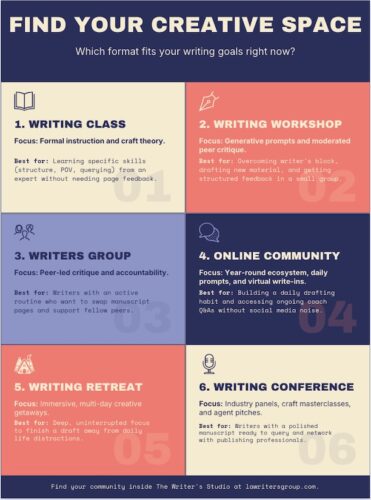
- Writing Class: Choose a class if you want formal, lecture-based instruction to learn specific craft mechanics (like point of view or plot structure) or industry logistics without receiving feedback on your manuscript.
- Creative Writing Workshop: Choose a workshop if you want an interactive, small-group setting to generate fresh pages through guided prompts and receive moderated, constructive peer critique.
- Writers Group: Choose a peer group if you already have an established drafting habit and want long-term critique partners to swap chapters and maintain mutual accountability.
- Online Writing Community: Choose an online community (like The Writer’s Studio) if you want a year-round, distraction-free creative home with daily writing prompts, weekday virtual write-ins, and ongoing coach access.
- Writing Retreat: Choose a retreat if you need an immersive, multi-day getaway away from daily distractions to focus deeply on completing or revising a draft.
- Writing Conference: Choose a conference if you have a polished manuscript ready to pitch to literary agents, want to attend industry panel discussions, and seek wide-scale publishing networking.
Writing Class vs. Writing Workshop vs. Writers Group vs. Online Writing Community
People often ask me what the difference is between a writing class, a creative writing workshop, a writers group (read about why I use writers group instead of writer’s group or writers’group), a writing conference, and writing retreats. For anyone new to the world of writing and publishing, these terms can be confusing, so let’s demystify them.
First, let me say that these three terms are often used interchangeably (and sometimes mislabeled). Having a clear understanding of the differences can help you find the place that is best for you and your budget.
Writing Classes
Think of a writing class as a place you go for formal, structured instruction. These classes are typically lecture-based and led by an instructor or author working from a curriculum. You aren’t bringing in pages for peer review; instead, you’re learning how craft and the industry work (e.g., mastering point of view, building a novel outline, writing query letters, or navigating traditional publishing or and self-publishing).
- Interaction: Instructor-to-student lecture with a dedicated Q&A.
- Goal: Skill acquisition and understanding craft theory or industry logistics.
- Size: Varies widely from intimate cohorts of 10 to webinars with hundreds of attendees.
- Locations: Online webinars, classrooms, private studios, or college extension programs.
- Where to Find Them: Search for specific topics rather than broad phrases (e.g., search for Novel Structure Class or How to Write a Query Letter Class rather than just writing class near me.
- Cost: Single-session lectures run from $30 to $150. Multi-week comprehensive courses range from a few hundred to over a thousand dollars.
- Choose if: You want to learn something specific or industry ins-and-outs and do not need feedback on your manuscript pages.
- Considerations:
- In large webinar formats, personal interaction will be limited.
- Teaching ability varies. Being a published author does not automatically mean someone knows how to teach craft effectively.
- Can be a quick and easy way to learn the basics of a particular subject.
- The cost of a class is not necessarily reflective of its quality.
Creative Writing Workshops
Think of a creative writing workshop as a generative lab or critique studio. It acts as a bridge between foundational learning and polishing work for publication. Workshops are led by an experienced facilitator who provides structured writing prompts to generate new work, moderates constructive group critique on manuscripts, or both.
- Interaction: Facilitator-guided peer interaction and moderated discussion.
- Goal: Generating new material through guided exercises and receiving structured, moderated feedback on works-in-progress.
- Size: Intimate. Usually capped between 6 and 12 writers to ensure everyone can participate.
- Locations: In-person studios/homes or live online (Zoom, etc).
- Where to Find Them: Search for “creative writing workshop” or “fiction critique workshop” + your city or “online”.
- Cost: Generally $30–$50 per hour of instruction (e.g., $60 for a 2-hour single session, or $350–$500 for a 6-week intensive).
- Choose if: You want a supportive, moderated space to draft new pages, overcome writer’s block, or get curated feedback on scenes.
- Considerations:
- Clarify submission limits in advance (workshops review chapters or short pieces, not entire completed novels in a single night).
- Ensure the facilitator enforces clear community guidelines so critique remains constructive rather than combative.
Writers Groups
Writers groups are peer-led communities. These are writers at similar stages in their journeys who meet regularly to keep each other accountable and swap feedback: You read my draft, and I’ll read yours.
- Interaction: Peer-to-peer. Usually self-governed without a paid instructor; however, some of these groups do have a paid leader.
- Goal: Mutual accountability, manuscript critique swaps, and project brainstorming.
- Size: Typically 4 to 8 members (larger groups often struggle with scheduling and reading loads).
- Locations: Local cafes, libraries, living rooms, private online communities, or virtual write-in rooms.
- Where to Find Them: Through writing class peers, local library boards, community platforms, or local writing organizations.
- Cost: Usually free (or splitting the cost of a room rental/online platform), but some groups have a paid leader.
- Choose if: You have or want to establish a regular writing habit, want ongoing accountability, and are ready to read and critique other writers’ pages regularly.
- Considerations:
- Unmoderated groups can devolve into social chats or dissolve when life gets busy.
- The quality of notes depends on the members’ craft knowledge. Watch out for groups that push you to homogenize your voice or leaders who try to dominate the room.
Online Writing Communities (or Creative Networks)
An online writing community is a centralized, ongoing creative home that bridges the gap between individual classes and solitary drafting. Unlike a single 6-week workshop with a hard end date, a writing community is a year-round membership platform (usually hosted on private networks like Mighty Networks or Circle) designed to provide daily momentum, co-working, craft discussions, and peer support and sharing.
- Interaction: Continuous, multi-channel engagement. Members interact with peers, community hosts, and resident coaches across discussion feeds, live virtual events, and dedicated topic spaces.
- Goal: Sustained daily writing habits, ongoing accountability, continuous craft education, and accessible peer connection between standalone projects or classes.
- Format: Virtual and asynchronous, accessible 24/7 via web or mobile apps, often paired with live scheduled events (like co-working sprints, Q&As, and masterclasses).
- Size: Medium to large (from dozens to hundreds of active writers), broken down into smaller genre groups, topic channels, or cohort spaces so it still feels personal.
- Where to Find Them: Independent writing organizations, craft platforms, or dedicated author networks. Look for private, ad-free platforms built specifically for writers rather than generic Facebook or Discord groups.
- Cost: Typically structured as a monthly or annual membership ranging from free tiers up to $30–$100+/month depending on the level of coaching, live write-ins, and direct editorial feedback included.
- Choose If: You want a consistent, low-friction writing routine, thrive on daily accountability check-ins, want to ask professional editors questions on the fly, and hate the isolation of writing alone.
- Considerations:
- Because access is ongoing, getting real value requires showing up regularly—even if just for 10 minutes a day to check a prompt or join a morning write-in.
- Look for communities with active moderation and clear culture guidelines to keep the space supportive and craft-focused.
💡 Looking for an ad-free creative home?
We created The Writer’s Studio—a private, supportive community network sponsored by Los Angeles Writers Group featuring daily prompts, weekday Zoom write-ins, live coach Q&As, and monthly page feedback. Join the waitlist here (doors open September 1)!
Writing Retreats vs. Writing Conferences
Writing Retreats
Writing retreats are immersive, creative getaways dedicated to drafting, revising, and/or recharging. Retreats range from self-directed solo getaways in a cabin to curated group travel experiences that blend dedicated writing blocks with excursions, workshops, or one-on-one coaching.
- Interaction: Small-group community with open writing time, occasional workshops, and facilitator check-ins.
- Goal: Escaping daily distractions to make substantial progress on a manuscript.
- Format: Multi-day to multi-week residential experiences.
- Where to Find Them: Search by genre or destination (e.g., “historical fiction writing retreat” or “California writers retreat”).
- Cost: Moderate to high ($800 to several thousand dollars depending on lodging, meals, travel, and coaching).
- Choose if: You need uninterrupted time away from your daily routine to finish a draft or break through creative exhaustion.
- Size: Can be a few people to thousands of people. If the website doesn’t say, ask about the anticipated number of attendees.
- Considerations:
- Check the daily balance between structured programming and open writing time.
- Verify what is included in the fee (lodging, meals, transit) versus what you must arrange independently.
- Research the retreat leader’s leadership philosophy and skills.
Writing Conferences
Writing conferences are large-scale professional industry events. They are packed with back-to-back panel discussions, craft masterclasses, keynote speeches, book vendor halls, and opportunities to pitch literary agents or meet with acquiring editors.
- Interaction: Industry professionals, authors, agents, and editors presenting to large audiences.
- Goal: Industry education, professional networking, and querying/pitching.
- Format: 2 to 4 full days with concurrent breakout sessions.
- Size: Several hundred to several thousand attendees.
- Where to Find Them: Search “writing conferences [upcoming year]” or browse directories like Poets & Writers or Writer’s Digest.
- Cost: Registration usually runs $300–$800+, plus travel, lodging, and optional add-on fees for agent pitch sessions or manuscript critiques.
- Choose if: You have a completed, polished manuscript ready to pitch, to learn craft, or want to learn about the current publishing market.
- Considerations
- Conferences are high-stimulation and can be exhausting—plan your schedule with intentional downtime.
- Remember that agent pitch sessions are brief business meetings; if an agent passes or gives blunt feedback, keep your perspective and focus on the overall learning experience.
- Consider bringing a friend.
- Bring an AI app to create a transcription and summary of the events you attend.
When looking for writing-related events, what are you currently looking for? Let us know in the comments below.
Comments are closed.
Warning: Trying to access array offset on null in /home/lawrit5/public_html/wp-content/themes/bootstart/comments.php on line 103
Warning: Trying to access array offset on null in /home/lawrit5/public_html/wp-content/themes/bootstart/comments.php on line 105
Warning: Trying to access array offset on null in /home/lawrit5/public_html/wp-content/themes/bootstart/comments.php on line 107